in-car entertainment system, which has evolved from a basic radio receiver into a comprehensive, interactive command center.
For automotive OEMs and Tier 1 suppliers, choosing the right display technology is critical to delivering a premium, safe, and engaging driving experience. This guide explores how advanced touch technologies are redefining the smart cockpit, and why partnering with an expert manufacturer is essential for producing reliable .
Redefining the Dashboard: The Role of Automotive HMI
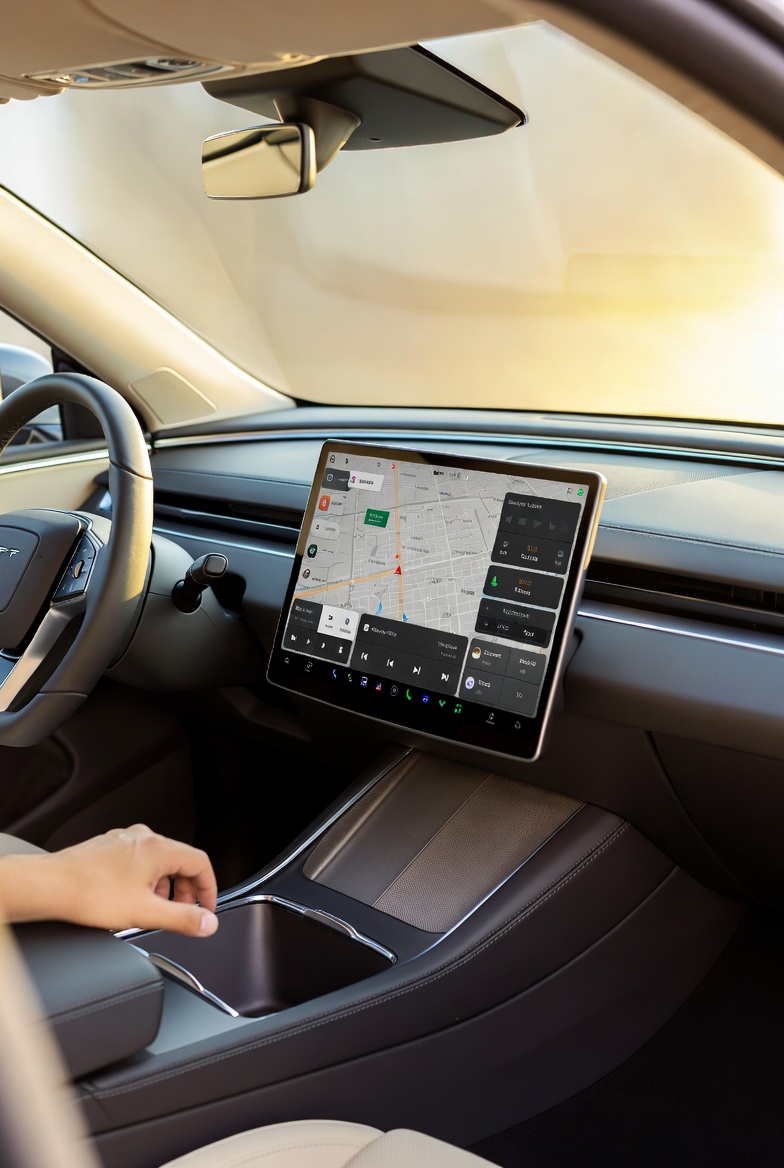
The Automotive HMI (Human-Machine Interface) is the bridge between the driver and the vehicle’s complex internal systems. A well-designed HMI ensures that this communication is seamless, intuitive, and, above all, safe.
Moving Beyond Traditional Dials and Buttons
Mechanical dials and physical buttons are rapidly being replaced by sleek, flat glass surfaces. Capacitive touch screens allow for dynamic interfaces that can change based on the driving context, offering a cleaner and more modern cabin aesthetic.
Centralizing Navigation, Media, and Vehicle Diagnostics
Modern in-car infotainment systems serve as the brain of the dashboard. A single, high-definition touch panel now controls GPS navigation, climate settings, audio playback, and advanced driver-assistance systems (ADAS) diagnostics, consolidating control into one accessible hub.
Balancing Rich Features with Driver Safety
While offering rich features is important, minimizing driver distraction is paramount. High-quality touch panels ensure instant response times (zero latency) and support multi-touch gestures, allowing drivers to adjust settings with a quick swipe rather than taking their eyes off the road to search for a menu.
Visual Brilliance: Specs for an Automotive Infotainment Display
The cabin of a car presents a unique optical challenge. An automotive infotainment display must remain perfectly legible whether driving through a dark tunnel or under blinding midday sun.
IPS Display Technology for Wide Viewing Angles
Unlike a computer monitor viewed straight on, a car display is viewed at an angle by both the driver and the passenger. We utilize IPS (In-Plane Switching) display technology to ensure that colors remain vibrant and text remains sharp from almost any viewing angle inside the vehicle.
Sunlight Readable Panels with High Brightness
To combat direct sunlight, automotive screens require significantly higher luminance than consumer tablets. We integrate high-brightness LED backlights (often exceeding 800-1000 nits) to ensure the screen does not wash out on sunny days.
Anti-Glare (AG) and Anti-Fingerprint (AF) Glass Coatings
A glossy screen creates dangerous reflections. We treat our custom cover glass with an Anti-Glare (AG) etched coating to scatter reflected light. Additionally, an Anti-Fingerprint (AF) oleophobic coating ensures the screen remains clean and easy to wipe, maintaining pristine visual clarity over years of use.
Modernizing the Console: The Car Touch Screen Radio
The aftermarket and mid-tier OEM markets are also seeing massive upgrades, particularly in the realm of the car touch screen radio.
Upgrading from Analog Systems to Multi-Touch Interfaces
Replacing traditional DIN and double-DIN analog radios with large, projected capacitive (PCAP) touch screens drastically modernizes the center console. Multi-touch capabilities allow for familiar smartphone gestures like pinch-to-zoom on navigation maps.
Seamless Support for Smartphone Integration (CarPlay/Android Auto)
Today's drivers demand seamless smartphone integration. Our touch modules are engineered for precise touch accuracy and rapid refresh rates, ensuring that mirroring platforms like Apple CarPlay and Android Auto function smoothly without lag or jitter.
Custom Touch Screen Module Integration for OEMs
For vehicle manufacturers, we offer deeply integrated custom display modules. We can match the exact curvature of the dashboard, design custom FPC (Flexible Printed Circuit) layouts to fit tight spaces, and integrate the display seamlessly into the vehicle's specific CAN bus architecture.
Durability and Safety: Thriving in the In-Car Environment
A display that looks beautiful but fails after a harsh winter is a liability. Automotive-grade reliability is what separates Xingyue Technology from standard display assemblers.
Wide Temperature Ranges (-40°C to +85°C)
Vehicles must survive in extreme climates. We select industrial-grade liquid crystals, robust IC controllers, and specialized adhesives that allow our screens to operate flawlessly in temperatures ranging from -40°C to +85°C, ensuring instant wake-up in freezing cold and preventing blackouts in scorching heat.
Preventing Condensation with Optical Bonding Technology
Temperature fluctuations inside a car can cause condensation (fogging) inside a standard air-bonded screen. We employ advanced optical bonding technology, filling the air gap between the touch sensor and the LCD with optical-grade resin. This eliminates internal moisture, prevents dust ingress, and massively improves impact resistance.
Meeting Automotive Vibration and Shock Standards
Constant road vibration can destroy weak electronics. Our display assemblies are reinforced mechanically and pass rigorous automotive shock and vibration testing standards, ensuring that FPC connections and internal components never shake loose.
The Next Frontier: Haptic Feedback and Curved Displays
As in-car displays evolve, Xingyue Technology is pushing the boundaries of what is possible in the smart cockpit.
Reducing Driver Distraction with Tactile Confirmation
To further reduce visual distraction, we are supporting the integration of localized haptic feedback. When a driver presses a digital button on the flat glass, the screen provides a subtle, physical vibration, offering tactile confirmation that the command was registered without needing to look at the screen.
Designing Ergonomic, Curved Smart Surfaces
The future of automotive interior design is curved. Leveraging flexible displays and custom-shaped 3D cover glass, we help manufacturers create sweeping, panoramic smart surfaces that wrap ergonomically around the driver.
Accelerating Your Automotive Display Innovations
The automotive infotainment display is no longer just a luxury feature; it is the defining element of the modern driving experience. To deliver a product that is visually stunning, highly responsive, and uncompromisingly durable, you need a manufacturing partner who understands the rigorous demands of the automotive industry.
Developing the next generation of smart cockpits or in-car entertainment systems? Partner with a display manufacturer that understands automotive standards. to discuss custom automotive touch screen solutions.
Frequently Asked Questions (FAQ)
1. Can capacitive touch screens work with polarized driving sunglasses? Yes, but it requires specific engineering. Standard LCDs emit polarized light, which can conflict with polarized sunglasses, causing the screen to look completely black from certain angles. We overcome this by utilizing specific polarizer orientations or adding circular polarizers to our in-car displays, ensuring perfect visibility for drivers wearing any type of sunglasses.
2. What makes a display "automotive grade" compared to standard industrial displays? While industrial displays are tough, "automotive grade" implies adherence to even stricter industry standards, such as AEC-Q100 guidelines for IC components and ISO 16750 for environmental testing. Automotive displays require an extended operating temperature range, superior vibration resistance, extremely low electromagnetic emissions (EMC), and guaranteed long-term supply longevity (typically 7-10 years) to match a vehicle's lifecycle.
3. Do you provide custom cover glass shapes for integrated vehicle dashboards? Absolutely. As a custom manufacturer, we excel at producing highly specialized cover glass. We can design glass with unique geometric cutouts for physical knobs, 2.5D or 3D curved edges to match the dashboard's contour, and custom silk-screened borders with your brand's specific color codes to create a truly unified Automotive HMI