Outdoor electronic devices, from EV charging stations and agricultural machinery to public information kiosks, are constantly exposed to the elements. While water and dust are obvious challenges, a more insidious threat is relentlessly attacking your display: Ultraviolet (UV) radiation. Have you ever seen an outdoor screen with peeled ink borders or a display that has turned a sickly yellow? This is the destructive work of UV light. This engineer's deep dive will explore the science behind UV degradation and provide a comprehensive guide to the various Anti-UV solutions available today, helping you prevent ink peeling and long-term material degradation.
The Enemy: How UV Radiation Degrades Outdoor Displays
Sunlight is a complex spectrum of radiation. While visible light allows us to see the display, the invisible UV portion, particularly in the 300-400nm wavelength range, carries high energy. This energy acts as a catalyst for photochemical reactions within the organic materials used in touch screens, such as inks, optical adhesives (OCA), and polarizers. Over time, this constant bombardment breaks down the chemical bonds in these materials, leading to two primary failure modes:
- Ink Peeling and Fading: The decorative ink border (bezel) on the cover glass loses its adhesion and color, peeling away from the glass.
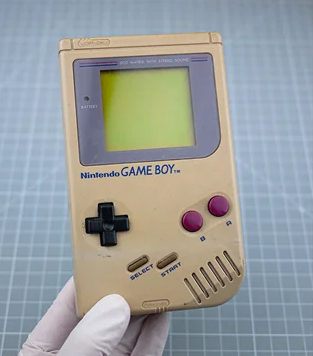
- Yellowing (Material Degradation): The optical adhesive or the display's top polarizer turns yellow and hazy, severely degrading the screen's optical performance and color accuracy.
Solution #1: Anti-UV Ink - A Cost-Effective First Line of Defense
One of the most common and cost-effective approaches is to use specially formulated anti-UV inks for the screen's printed border.
How It Works: Inks like Seiko GV3 or Miramar GLE-5001 contain additives that are more resistant to UV degradation than standard inks.
- Advantages:
- Low Cost: It is a relatively inexpensive solution compared to modifying other components.
- Targeted Protection: It directly addresses the common problem of ink peeling and fading.
- Limitations:
- Limited Scope: This method only protects the ink itself. It offers no protection for the optical adhesive or the display's polarizer in the transparent viewing area (VA), where UV light can pass through unimpeded.
- Manufacturing Complexity: These specialized inks can be more challenging to work with during the screen-printing process compared to standard inks.
Solution #2: Anti-UV OCA/Film - A Deeper Layer of Protection
A more robust solution involves integrating UV-blocking capabilities directly into the adhesive layers of the touch panel stack-up.
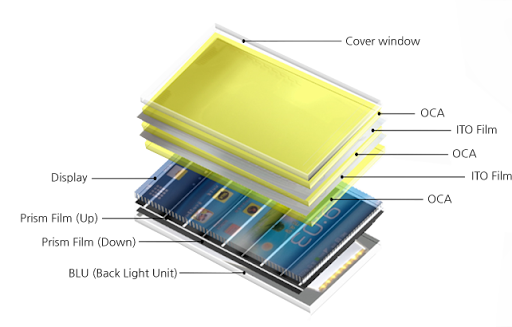
How It Works: This can be achieved in two ways:
- Anti-UV Film + Standard OCA: A dedicated anti-UV film is laminated between the cover glass and the standard optical clear adhesive (OCA).
- Anti-UV OCA: A specialized optical clear adhesive that has UV-blocking additives mixed directly into its formula is used.
Both methods are highly effective, capable of blocking nearly 100% of UV radiation below the 400nm wavelength.
- Advantages:
- Comprehensive Protection: Protects all layers beneath the adhesive, including the sensitive polarizer of the TFT display.
- High Efficacy: Offers a very high UV-blocking rate.
- Limitations:
- Material Degradation: The anti-UV adhesive or film itself is absorbing the UV energy. Over a very long period, this can still lead to the adhesive layer slowly degrading and yellowing.
- Increased Cost and Complexity: It adds an extra material or requires a more expensive specialized adhesive, and may add a step to the lamination process.
Solution #3: Ceramic Ink - The Ultimate in UV Stability
For the printed border area, ceramic ink offers a near-permanent solution to UV degradation.
How It Works: Ceramic ink is made from inorganic materials. During the glass tempering process, the ink is fired at high temperatures, causing it to fuse with the glass surface and become a stable, inorganic layer.
- Advantages:
- Exceptional Durability: As an inorganic material, it is virtually immune to UV radiation. It will not fade, yellow, or peel over the lifetime of the product.
- Limitations:
- Process Constraints: It requires high-temperature processing, which means it can typically only be used on tempered glass with a thickness of 2.0mm or more. This adds significant weight and thickness to the final design.
- No VA Protection: Like anti-UV ink, it only protects the printed border. The transparent viewing area remains completely unprotected.
The Premier Solution: Anti-UV Coating on the Cover Glass Surface
The most comprehensive and technically elegant solution is to apply a specialized anti-UV coating directly to the surface of the cover glass.
How It Works: A multi-layer optical thin-film coating is deposited onto the glass surface via a vacuum deposition process. This coating is engineered to reflect or absorb UV radiation before it can even enter the display stack-up.
- Advantages:
- Total Protection: It protects every single component beneath the cover glass, including the ink, the optical adhesive, and the display itself. This allows standard, more cost-effective materials to be used for all internal layers.
- Extremely High Performance: A well-designed coating can block over 95% of UV radiation (315-400nm) while maintaining a very high visible light transmittance of over 92%.
- Limitations:
- Visual Artifacts: This type of coating often produces a slight blue or purplish reflective tint on the glass surface. Critically, there can be minor color variations between different production batches that are currently difficult to control.
- Higher Cost: This is a premium process that adds a significant cost to the cover glass.
Verification: Understanding Anti-UV Accelerated Aging Tests (ASTM G154)
How can you be sure an anti-UV solution will work for years in the field? Reputable manufacturers use standardized accelerated aging tests to validate their designs. One of the most common standards is ASTM G154.
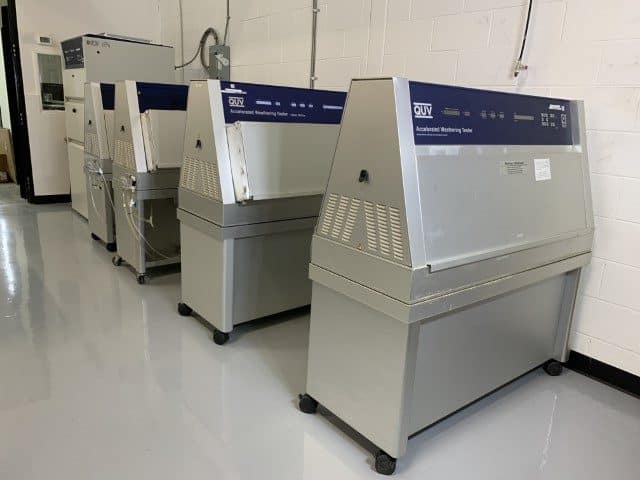
This test uses fluorescent UV lamps in a controlled chamber to simulate years of sun exposure in a much shorter time. A typical test duration of 1,000 hours is generally considered equivalent to more than 5 years of real-world outdoor exposure to sun and moisture. By comparing a product's appearance and performance before and after this test, we can reliably verify the long-term effectiveness of an anti-UV solution.
Choosing the Right Anti-UV Strategy for Your Outdoor Device
There is no single "best" anti-UV solution. The optimal choice depends on a careful analysis of your product's specific requirements:
- For budget-conscious projects where only ink peeling is a concern, Anti-UV Ink is a viable starting point.
- For high-reliability devices where the display itself must be protected, an Anti-UV OCA or Film is a strong choice.
- For applications demanding the ultimate in border durability where weight is not a concern, Ceramic Ink is unparalleled.
- For mission-critical outdoor devices where total protection is required and a premium cost is acceptable, an Anti-UV Surface Coating is the premier solution.
By understanding these trade-offs, you can engineer an outdoor display that not only looks great on day one but continues to perform flawlessly for years to come.
Frequently Asked Questions (FAQ)
Which anti-UV solution offers the best cost-performance ratio for most applications?
For most mid-to-high-range outdoor applications, using an Anti-UV OCA often provides the best balance. It offers comprehensive protection for the critical display components at a more moderate cost than a full surface coating, representing an excellent cost-performance ratio.
How does an anti-UV coating affect the screen's optical performance and touch sensitivity?
A high-quality anti-UV surface coating is designed to have minimal impact on performance. Visible light transmittance remains very high (>92%), so brightness is not significantly affected. It has no impact on the functionality of the capacitive touch sensor, as the sensor operates based on an electric field, not light.
Can these solutions be combined? For example, using anti-UV ink with an anti-UV OCA?
Yes, solutions can be combined for maximum protection, though it may be redundant in some cases. A common combination is using Ceramic Ink for ultimate border protection and an Anti-UV OCA to protect the viewing area. This creates an extremely durable solution for the most demanding environments. Unsure which Anti-UV solution is right for your product? Contact our engineering team for a free consultation.